“Ah Long” or a Licensed Moneylender: How to Spot the Difference in 5 Minutes
“Ah Long” or a Licensed Moneylender: How to Spot the Difference in 5 Minutes

When someone urgently needs money, it’s easy to accept terms that would feel suspicious in a calmer moment. That’s what people pretending to be lenders rely on: they promise a fast loan, then pivot to a “small mandatory fee” before any money is disbursed.
Below is a simple way to think about it: what requests should raise red flags, what’s normal in online lending, and what you can verify in just a few minutes before you send documents or money.
How it usually starts: a message or call saying “we can approve you fast”
Often the first contact isn’t a bank website or a familiar app—it’s a DM in a messenger app, a social media ad, or a call from an “agent” offering to arrange a loan. They might say:
- you’ll get a decision the same day;
- minimal documents are needed;
- the money will be sent “right after confirmation.”
From these lines alone, you can’t tell whether the offer is legitimate. The difference shows up in the next step—what they ask you to do.
Red flag #1: they ask you to pay before you receive any money
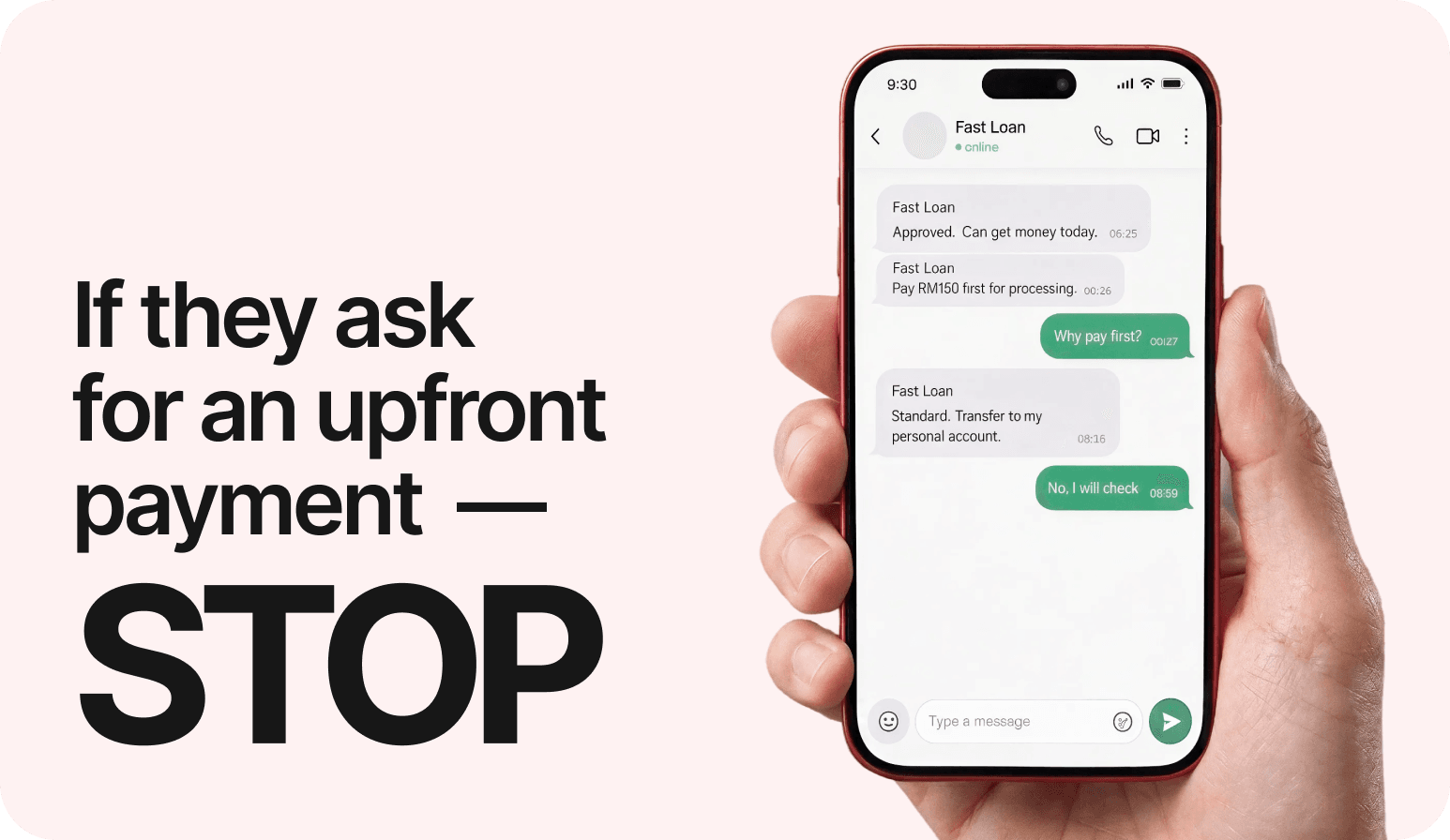
The most reliable indicator is an upfront fee.
If they ask for a “deposit,” “processing fee,” “insurance,” “tax,” or any other payment before you receive the loan funds, that’s a common scam structure: one small payment first, then another “required” one, then another—until you stop.
A practical rule: if they ask for money upfront, pause and double-check everything.
Red flag #2: they ask you to transfer money to a personal account
Sometimes the upfront fee is explained confidently: “that’s how the process works,” “the system requires it,” “it’s standard.” At that point, details matter.
Ask yourself (and them) a direct question: whose name is on the account you’re supposed to transfer money to?
If the recipient details belong to an individual—a “manager,” “agent,” or “partner”—that’s a serious warning sign. Bank and consumer warnings often describe cases where people are pressured into sending “fees” to personal or third-party accounts.
8 signs you should pause and re-check everything
To avoid keeping dozens of details in your head, use this simple rule: the more you’re pushed to act fast without clear terms, the higher the risk.
- They won’t show the terms upfront: total repayment, schedule, fees, and penalties.
- The terms shift during the conversation: new payments or requirements appear that weren’t mentioned earlier.
- They rush you: “decide now,” “this will expire in 10 minutes.”
- They answer questions vaguely or irritably.
- They move you into private chats and discourage using official channels.
- Instead of official support, an “agent” runs everything and asks for exceptions to the rules.
- Pressure escalates—from emotional manipulation to threats.
- The deal includes an upfront fee or transfers to personal/third-party details—stop and go back to the checks above.
What’s normal in online applications—and what should worry you
A common source of anxiety is OTPs and verification calls. These steps alone don’t prove it’s a scam: services do need to confirm contact details and clarify information on an application.
Usually normal:
- an OTP to confirm your phone number;
- a short call to verify details;
- waiting for bank processing of a transfer.
Not normal:
- demands to pay for “activation/verification/unlocking” before receiving funds;
- requests to send such payments to personal or unclear accounts.
The boundary is simple: verification confirms identity and details; it shouldn’t turn into a chain of upfront payments.
A 5-minute check: what you should be able to verify before you share documents or send money
If you want to be careful, you don’t need to be a finance expert. You just need to verify a few basics—either they’re there, or they aren’t.
A good rule of thumb is whether this information is clearly available upfront. For example, with Tambadana you can find these details on the website and check them before you decide.
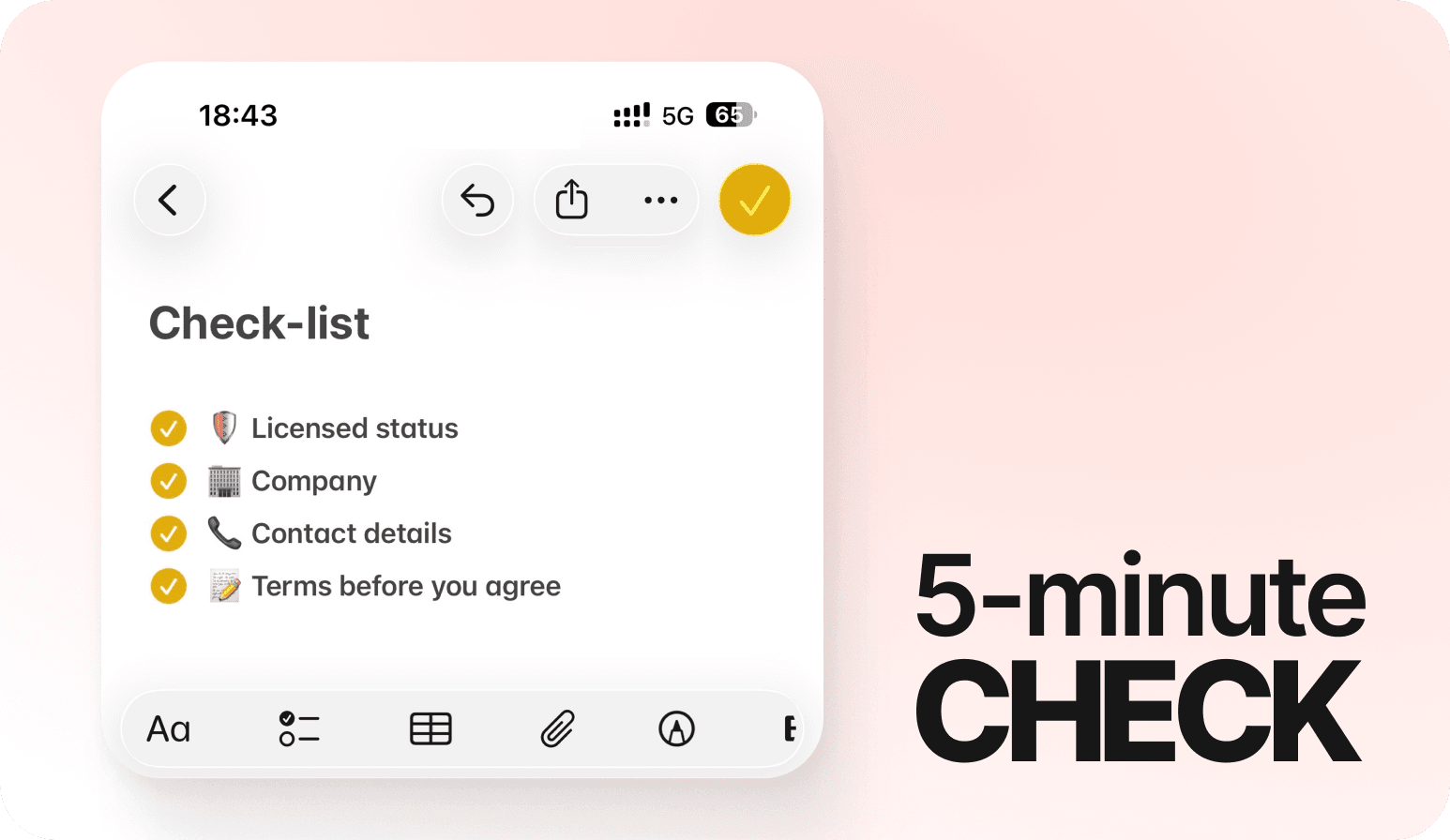
1) Licensed status: verify first
In Malaysia, borrowers are commonly advised to verify moneylenders through official sources and regulator tools.
A simple first step is to use i‑KrediKom (KPKT’s official portal): https://www.kpkt.gov.my/index.php/pages/view/361 — it allows you to check whether a specific moneylender is licensed, based on the provider’s details.
If you can’t find the lender there (or the details don’t match), pause and verify again through official contacts before you share documents or proceed.
2) Company: who exactly is issuing the loan
A site should clearly show which company is providing the loan: name and registration details.
Example (Tambadana):
- Company: Wawasan Cojaya Sdn Bhd (registration no. 201401047621 / 1123810‑P)
- i‑KrediKom check: License No. WL6646/14/01‑6/301127 (valid 01/12/2025 – 30/11/2027)
- Advertising permit: WP6646/14/01‑5/301127 (valid 01/12/2025 – 30/11/2027)
3) Contact details: how to reach them directly (not via a “middleman”)
Phone, email, business hours. This isn’t just formal—so you can contact the provider directly, not through an “agent.”
4) Terms: what you should see before you agree
A valid licence is the first check, not the only one. Before you accept any loan offer, make sure you understand:
- the total repayment amount;
- the repayment schedule;
- fees and penalties.
If doubts show up mid-chat: what to do right now
- Pause: don’t send money “to finish the process.”
- Document: save the chat, numbers, payment details, and links.
- Verify: find official contacts and cross-check company details using official sources.
- If you already paid or shared sensitive data: contact your bank/payment provider as soon as possible and ask what actions are available (cancel, dispute, restrict activity).
- Don’t act under pressure: “urgent or else…” is a reason to stop, not speed up.
A good deal doesn’t require guesswork
If the terms keep changing or you’re being rushed to decide, pause. Re-check the basics and use official channels only.
When the key details are clear and you’ve done the basic checks, you can move forward with confidence.